Multi-purpose tokens (MPTs) represent the next generation of fungible tokens on the XRP Ledger, designed for institutional use cases.
- Authorize, receive, send, and track MPT balances in Ripple Custody.
- Automatic ticker creation when MPT payments are received.
- On-chain metadata with standardized schema for token properties.
Traditional tokenization on the XRP Ledger uses trust lines, which were designed for a different era. MPTs address these limitations with a cleaner architecture built for institutional adoption.
Benefits: Unidirectional transfers eliminate rippling complexity. Token properties are stored on-chain, not in external systems. Holders must opt in before receiving any MPT, preventing spam.
Use cases: Tokenized securities and RWAs, stablecoins, loyalty programs, and gaming currencies.
Before working with MPTs, you should understand:
- Blockchains and ledgers — XRP Ledger accounts, transactions, and ledger concepts.
- Ripple Custody Auth & Sign mobile app — Required to sign MPT transaction intents.
Tokenization is the process of representing real-world or digital assets as blockchain tokens. On the XRP Ledger, tokenization enables:
- Divide high-value assets into smaller, tradeable units.
- Transfer ownership instantly, without intermediaries.
- Enforce transfer restrictions and regulatory requirements at the protocol level.
- Enable cross-border transactions with reduced friction.
The XRP Ledger supports two types of fungible tokens: trust line tokens and multi-purpose tokens. While trust line tokens have served the ecosystem well, MPTs address their limitations with a cleaner architecture designed for institutional adoption.
MPTs were designed based on lessons learned from trust line tokens. The following table summarizes the key differences:
| Feature | Trust line tokens | Multi-purpose tokens |
|---|---|---|
| Identifier | Currency code (3-char or 40-char hex) | 192-bit Issuance ID |
| Direction | Bidirectional (supports rippling) | Unidirectional only |
| Metadata | None (off-chain only) | Up to 1024 bytes on-chain |
| Settings scope | Per-account (affects all tokens) | Per-issuance (granular control) |
| Supply cap | Not enforceable | Configurable maximum quantity |
| Transfer fees | Percentage-based | Percentage-based |
| Compliance | Freeze and clawback available | Freeze, clawback, and authorization |
MPTs intentionally omit features like rippling that introduce edge cases, resulting in a simpler conceptual model that is easier to reason about and integrate.
The following properties are inherent to all MPTs on the XRP Ledger:
- Anyone can be an issuer. Every account can issue tokens, and you can create many different issuances from a single account. Each issuance can have different settings.
- Issuers cannot hold their own tokens. Tokens sent to the issuer are automatically burned. Use separate operational accounts if you need to hold your own tokens.
- Holders must opt in. Recipients must authorize an MPT before they can receive it, preventing unwanted token spam.
MPT operations are divided between two distinct roles:
| Role | Description | Available operations |
|---|---|---|
| Issuer | Creates and controls the MPT issuance | Create, mint, burn, freeze, clawback, authorize holders, destroy |
| Holder | Receives and transfers MPTs | Authorize (opt-in), receive, send, check balances |
An account can act as both an issuer (for MPTs it creates) and a holder (for MPTs created by others).
Ripple Custody supports issuer operations for creating and managing MPT issuances, and holder operations for receiving and transferring MPTs.
MPT operations are available in the UI and with API workflows. Before submitting MPT transactions to the ledger with the API, use the Perform a dry run for an intent operation to validate MPT-specific requirements such as flag settings, holder authorization status, token balances, and lock status.
| Role | Operation | UI procedure | API procedure |
|---|---|---|---|
| Issuer | Create an issuance | Create token | MPTokenIssuanceCreate |
| Issuer | Authorize or revoke a holder | Authorize holder, Revoke holder | MPTokenAuthorize |
| Issuer | Mint tokens to a holder | Transfer token from the issuer account | Payment |
| Issuer | Burn tokens | Transfer token to the issuer account | Payment |
| Issuer | Freeze or unfreeze one or all holders | Freeze one or all holders, Unfreeze one or all holders | MPTokenIssuanceSet |
| Issuer | Claw back tokens | Clawback | Clawback |
| Issuer | Finish an escrow | Use the API procedure. | EscrowFinish |
| Issuer | Destroy an issuance | Destroy token | MPTokenIssuanceDestroy |
| Holder | Opt in to an MPT | Opt in to token | MPTokenAuthorize |
| Holder | Receive MPTs | Release quarantined transfers | Receive assets |
| Holder | Send MPTs | Transfer token | Transfer order or Payment |
| Holder | Check balances | Open the account's Overview tab. | Check balances |
To perform an MPT operation in the UI, open the account, click Create order, select Ledger-specific operations, and select the XRP Ledger network. The Operation list groups the MPT operations under Multi-purpose tokens (MPT). Transfer token and Clawback are listed at the top, because they apply to both MPTs and trust line tokens.
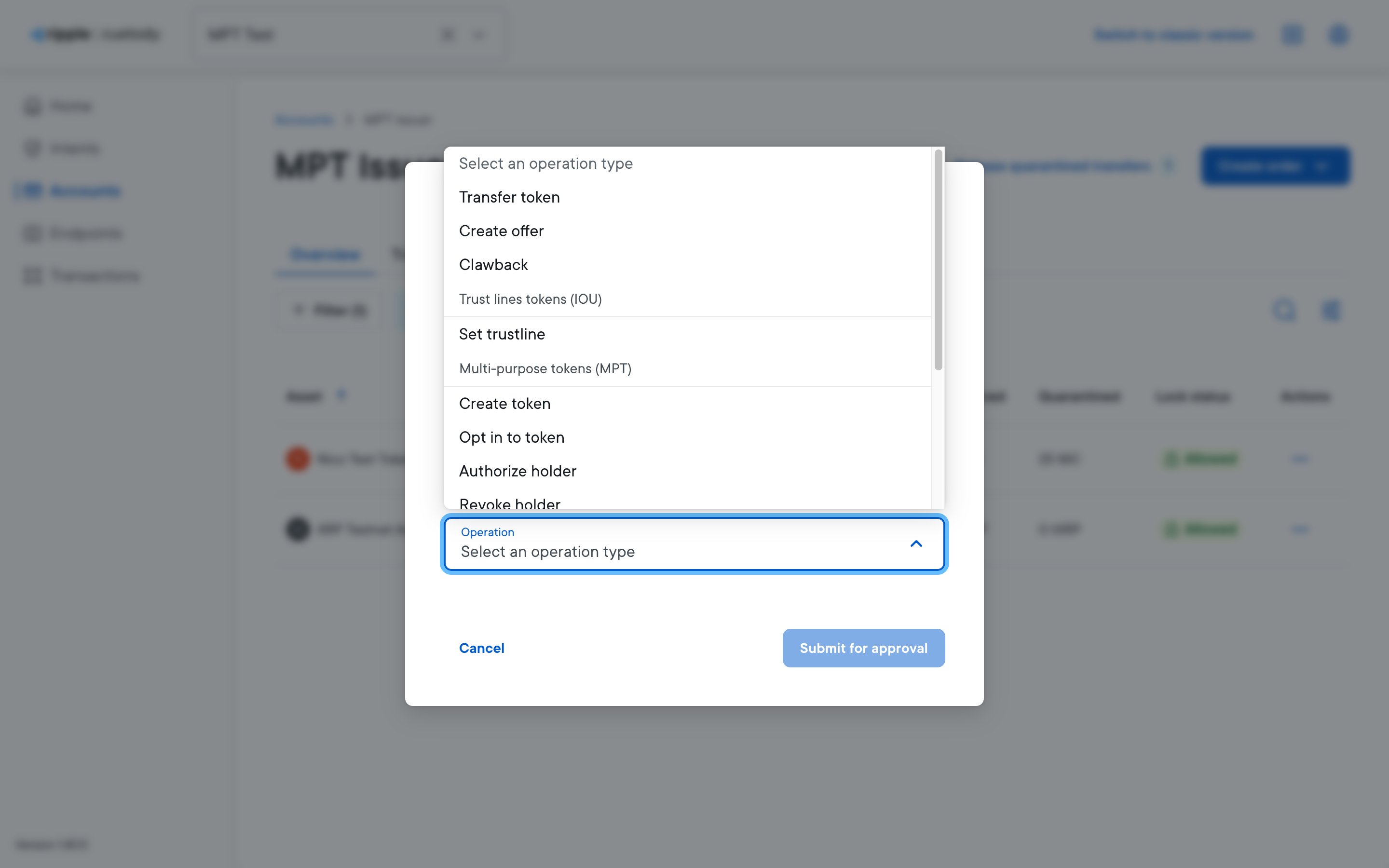
Operations that target an existing MPT let you pick the token in one of two ways:
- Listed asset — Select the token from the list of assets registered in Ripple Custody. Use this when the MPT's ticker is allowlisted, so you don't need to enter the issuance ID.
- Unlisted asset — Enter the token's issuance ID. Use this for a new MPT that isn't registered yet, for example right after you create it, or before your account has received it.
When you transfer or claw back an unlisted MPT, enter the amount in base units. The UI has no asset scale for unlisted assets, so it sends the value to the ledger unchanged. For an MPT with an asset scale of 2, enter 100000 to send 1,000.00 tokens.
Each operation creates an intent that you sign with the app. The signing window shows a recap of the operation, including the issuance ID.
MPTs follow a defined lifecycle from creation to destruction:
- Create — The issuer creates the MPT issuance with
MPTokenIssuanceCreate, defining metadata and flags. - Authorize — Holders opt in to receive the MPT with
MPTokenAuthorize. - Mint — The issuer sends tokens to holders using
Paymenttransactions. - Transfer — Holders transfer tokens among themselves (if
lsfMPTCanTransferis enabled). - Burn — Tokens returned to the issuer are automatically burned.
- Destroy — The issuer can destroy the issuance with
MPTokenIssuanceDestroywhen supply reaches zero.
Each MPT issuance is uniquely identified by a 192-bit identifier (displayed as 48+ hexadecimal characters):
00070C4495F14B0E44F78A264E41713C64B5F89242540EE255534400000000000000The Issuance ID is generated by the XRP Ledger when the issuer creates the MPT. Unlike currency codes, Issuance IDs are not intended for display to end users—use the token's metadata for human-readable identifiers.
Every MPT issuance includes on-chain metadata stored in the MPTokenIssuance ledger entry. This metadata contains both functional and non-functional data:
Functional data:
- Transfer fee percentage.
- Maximum supply cap.
- Transferability settings.
Non-functional data:
- Asset scale (decimal precision).
- Up to 1024 bytes of arbitrary metadata (typically JSON).
MPT metadata follows the XLS-89 standard. To fit within the 1024-byte limit, the schema uses compressed JSON keys:
| Field | Key | Required | Description |
|---|---|---|---|
| ticker | t | Yes | Token symbol (uppercase letters and digits, max 6 characters recommended) |
| name | n | Yes | Display name of the token |
| desc | d | No | Short description |
| icon | i | Yes | URI to the token icon |
| asset_class | ac | Yes | Primary category: rwa, memes, wrapped, gaming, defi, or other |
| asset_subclass | as | Conditional | Required when asset_class is rwa |
| issuer_name | in | Yes | Name of the issuing entity |
| uris | us | No | Array of related URIs (website, docs, social) |
| additional_info | ai | No | Freeform field for additional details |
The asset_class field categorizes tokens by their primary purpose:
| Class | Description |
|---|---|
rwa | Real-world assets with legally enforceable claims on physical or financial assets |
memes | Community-driven tokens without intrinsic backing |
wrapped | Tokens representing assets from other blockchains |
gaming | In-game currencies, assets, or rewards |
defi | Governance tokens, DEX tokens, and lending assets |
other | Experimental or unique use cases |
When asset_class is rwa, specify an asset_subclass: stablecoin, commodity, real_estate, private_credit, equity, treasury, or other.
{
  "t": "TBILL",
  "n": "T-Bill Yield Token",
  "d": "A yield-bearing stablecoin backed by short-term U.S. Treasuries.",
  "i": "example.org/tbill-icon.png",
  "ac": "rwa",
  "as": "treasury",
  "in": "Example Yield Co.",
  "us": [
    {"u": "exampleyield.co/tbill", "c": "website", "t": "Product Page"},
    {"u": "exampleyield.co/docs", "c": "docs", "t": "Documentation"}
  ],
  "ai": {
    "interest_rate": "5.00%",
    "maturity_date": "2045-06-30",
    "cusip": "912796RX0"
  }
}MPT balances are stored as raw integers. The AssetScale field (0–19) defines how to interpret the decimal position:
| AssetScale | Raw value | Display value |
|---|---|---|
| 0 | 1000 | 1000 |
| 2 | 150000 | 1500.00 |
| 6 | 1500000 | 1.500000 |
Ripple Custody automatically applies the MPT's AssetScale to display balances with correct decimal precision.
MPTs support three levels of transferability:
| Level | Configuration | Behavior |
|---|---|---|
| Freely transferable | lsfMPTCanTransfer enabled, lsfMPTRequireAuth disabled | Any holder can transfer to any other account |
| Authorized holders only | lsfMPTCanTransfer enabled, lsfMPTRequireAuth enabled | Only issuer-approved accounts can hold or receive |
| Non-transferable | lsfMPTCanTransfer disabled | Tokens can only move between holders and the issuer |
MPTs include built-in compliance capabilities:
When lsfMPTCanLock is enabled during issuance, the issuer can freeze tokens:
- Individual freeze — Block a specific holder from sending or receiving.
- Global freeze — Block all transfers of the token (except to/from the issuer).
When lsfMPTCanClawback is enabled, the issuer can reclaim tokens from any holder without consent. This is useful for:
- Recovering tokens sent to incorrect addresses.
- Enforcing legal or regulatory requirements.
- Responding to security incidents.
Before accepting an MPT as collateral or for custody, verify the token's flags. Tokens with lsfMPTCanClawback enabled may be reclaimed by the issuer at any time.
MPT behavior is controlled by flags set during issuance. Most flags are immutable after creation.
| Flag | Description |
|---|---|
lsfMPTCanLock | Issuer can freeze individual holders or the entire token. |
lsfMPTRequireAuth | Holders must be authorized by the issuer before receiving. |
lsfMPTCanTransfer | Holders can transfer tokens to each other. |
lsfMPTCanClawback | Issuer can reclaim tokens without holder consent. |
lsfMPTCanEscrow | Tokens can be placed in escrow. |
lsfMPTCanTrade | Tokens can be traded on the DEX. |
| Flag | Description |
|---|---|
lsfMPTLocked | When set, all transfers are blocked (global freeze). |
- Send assets — Send assets, including supported token transfers, with the API.
- Receive assets — Receive and release incoming transfers.
- Blockchains and ledgers — Supported blockchain networks.
- Multi-purpose tokens (XRPL documentation) — Protocol-level reference.