Reconcile incoming payments by checking their receipt status, their settlement links, and the status of each payout. Keep two views: the payments in the period you are closing, and the complete payouts that include those payments. A payout can span periods and beneficiary accounts.
In this guide, a payment is money that arrives through a channel, and the API records each one as a transaction. A payout is money that Ripple sends to your bank, and the API records it as a settlement. The receipt window is the period whose payments you are closing, and the payout window is the period whose settlements you are reviewing.
Not every payout links to the payments it includes. A balance-funded payout draws on the account balance as a whole, so it can have no links to individual payments. Reconcile those with balance records and the supporting records Ripple provides, rather than treating a missing settlement link as proof that no payout occurred.
Every call in this guide is a GET, so a reconciliation run creates nothing and is safe to repeat.
You need:
- An access token. Authentication describes how to get one.
- The
account_idof each account you reconcile. - A payout record to match payouts against. In production, use your bank statement or another record of the money arriving. UAT simulates payouts, so no real bank credit arrives.
You can run the API steps without the following, but you need them before you close a period. Agree on the following with Ripple:
- Supporting records: Some payouts do not link to the payments they include, so the API alone cannot account for every part of a payout. Ask Ripple which report or assisted reconciliation process covers your account, how you get it, and what period it covers. Obtain supporting records lists what to request.
- Payout processing time: Agree how long a payout normally takes for your rail and setup, so you can tell when a payout is overdue.
- UAT test evidence: In UAT, agree which record shows that a simulated payout completed.
This guide assumes you know what transactions, settlements, channels, and accounts are.
Reconciliation spans three objects joined by two identifiers on the transaction:
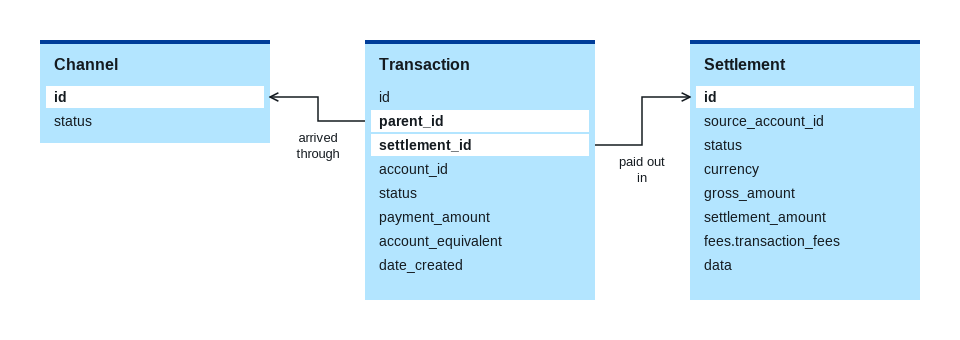
transaction.settlement_idjoins to the payout side. Ripple sets it at the time it includes the transaction in a settlement, which happens while that settlement is stillPENDING. So a populatedsettlement_iddoes not, by itself, mean the payout has happened.transaction.parent_ididentifies the channel the payment arrived through.- Ripple pays a settlement from a
CUSTOMER-owned account. For payments through a beneficiary'sPARTNER-owned account, this differs from the transaction'saccount_id. Automatic balance movements or transfers move the funds to the customer account before payout. - A converted payment arrives in a different currency from the account it credits, such as USDT into a USD account, so Ripple converts it. Depending on your configuration, Ripple pays out each converted payment on its own, as an instant payout. Otherwise, it bundles your unsettled converted payments in one currency when you request a settlement. Bundles have size and funding limits, so one request need not include every unsettled payment. Ripple never bundles an instant payout: each one carries exactly one converted payment.
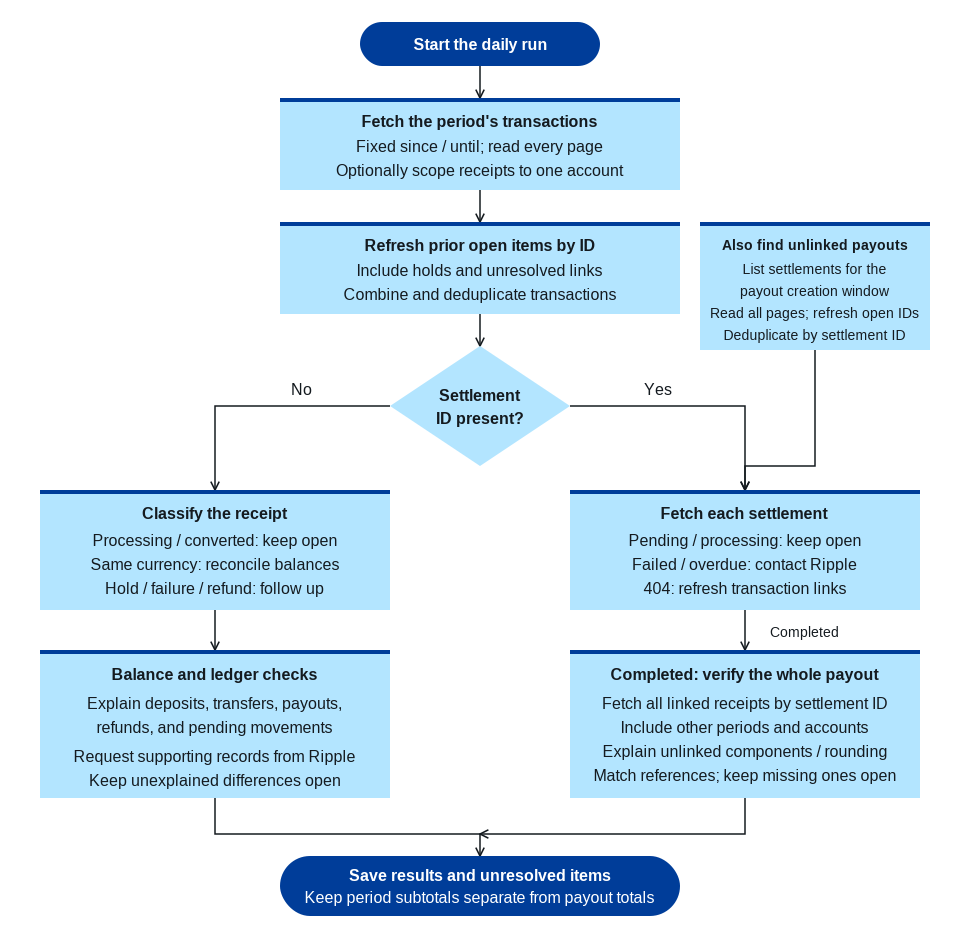
The five steps below follow that shape. Read the transactions and group them by settlement. Classify the ones without a settlement link, and verify each linked settlement. Then find the payouts that no transaction links to. A daily reconciliation run puts the steps together and saves what is still open for the next run.
Pass the start and end of the period you are closing as since and until. Both are inclusive and compare against the transaction's date_created:
GET /v1/collections/transactions?since=2026-08-10T00:00:00Z&until=2026-08-11T00:00:00Z&page=0&size=100
Authorization: Bearer {access_token}
To reconcile a single account, add account_id. A since later than until returns 400 with the code INVALID_PARAMETER, rather than an empty page.
A trimmed response:
{
  "content": [
    {
      "id": "f30ab512-8c74-4e69-b1d2-05a8e6c37f90",
      "parent_id": "c91b5d02-3e77-4a18-9f6c-2d4b8e0a1573",
      "account_id": "a1b2c3d4-e5f6-7890-abcd-ef1234567890",
      "settlement_id": null,
      "payment_amount": { "value": "300.00", "asset": "USDC" },
      "status": "HOLD_KYT",
      "reason": null,
      "date_created": "2026-08-10T18:20:11.006Z"
    },
    {
      "id": "2b6e94c7-1d5a-4c83-9e07-af2b3c4d5e61",
      "parent_id": "7f4c2e18-6a9b-4d30-8c51-b2e9f70a3d44",
      "account_id": "a1b2c3d4-e5f6-7890-abcd-ef1234567890",
      "settlement_id": null,
      "payment_amount": { "value": "50.00", "asset": "USDC" },
      "account_equivalent": {
        "gross_amount": { "value": "50.00", "currency": "USD" },
        "fee_amount": { "value": "0.50", "currency": "USD" },
        "net_amount": { "value": "49.50", "currency": "USD" }
      },
      "status": "COMPLETED",
      "reason": null,
      "date_created": "2026-08-10T15:38:05.442Z"
    },
    {
      "id": "9c1d77e2-4f08-42b1-8a35-6be0c1d95f74",
      "parent_id": "e8d43598-107d-4694-9fb2-934e7484c3d4",
      "account_id": "a1b2c3d4-e5f6-7890-abcd-ef1234567890",
      "settlement_id": "63dd59dd-88be-41a2-a246-2f6724209422",
      "payment_amount": { "value": "150.00", "asset": "USDT" },
      "account_equivalent": {
        "gross_amount": { "value": "150.00", "currency": "USD" },
        "fee_amount": { "value": "1.50", "currency": "USD" },
        "net_amount": { "value": "148.50", "currency": "USD" }
      },
      "status": "COMPLETED",
      "reason": null,
      "date_created": "2026-08-10T11:02:47.903Z"
    },
    {
      "id": "487ba009-56cf-4ad9-8b5c-045e27893e00",
      "parent_id": "22a0337b-8e62-449c-91ca-a0f830c55733",
      "account_id": "a1b2c3d4-e5f6-7890-abcd-ef1234567890",
      "settlement_id": "63dd59dd-88be-41a2-a246-2f6724209422",
      "payment_amount": { "value": "50.00", "asset": "USDT" },
      "account_equivalent": {
        "gross_amount": { "value": "50.00", "currency": "USD" },
        "fee_amount": { "value": "0.50", "currency": "USD" },
        "net_amount": { "value": "49.50", "currency": "USD" }
      },
      "status": "COMPLETED",
      "reason": null,
      "date_created": "2026-08-10T09:14:22.117Z"
    }
  ],
  "page": { "page": 0, "size": 100, "total_elements": 4, "total_pages": 1 }
}
Capture id, settlement_id, status, account_id, payment_amount, and account_equivalent when present. The API omits account_equivalent while a cross-currency payment awaits its deferred conversion, including during a compliance hold. Keep the received amount and status; do not invent an account-currency amount or treat it as zero.
page is zero-indexed and size defaults to 10. A run that reads only the first page drops transactions without reporting an error, which produces a reconciliation that balances against incomplete data. Set size to a larger value, such as 100, then increase page by 1 until you reach the last page:
page = 0
repeat
  GET /v1/collections/transactions?since={start}&until={end}&page={page}&size=100
  append response.content to transactions
  page = page + 1
until page >= integer(response.page.total_pages)
Parse the page fields as integers before you compare them. Responses can send page, size, total_elements, and total_pages as strings, such as "2", and comparing a number with a string gives the wrong answer in most languages.
Keep the window fixed for the whole run. A payment that arrives while you page through a window that ends now can shift the pages and repeat or skip a transaction.
Also re-fetch each open transaction saved from earlier runs with GET /v1/collections/transactions/{transaction_id}. The date filters select creation time, not the time a status or settlement link changed. Combine those refreshed records with the current window and deduplicate by id. Keep each refreshed transaction's original receipt period so resolving an old item does not count it as a new receipt.
Because both bounds are inclusive, a transaction created at the exact instant where one window ends and the next begins appears in both. Assign it to the later period, the one that starts at that instant.
Partition the results on settlement_id:
- In a settlement:
settlement_idholds an identifier. Group these bysettlement_id. Several transactions share one identifier when Ripple bundled them into the same payout. Each group becomes one verification in Step 4. - No settlement link:
settlement_idisnull. The transaction may be waiting for a settlement, its status may prevent one, or a payout may have used balance without linking the payment. Step 3 sorts out the follow-up.
In the response above, transactions 487ba009 and 9c1d77e2 group under settlement 63dd59dd-88be-41a2-a246-2f6724209422. Transactions 2b6e94c7 and f30ab512 have no settlement links.
Use the window to classify receipts. Use the full settlement membership to check payout totals. Do not compare a window or single-account subtotal with the entire settlement amount. Step 4 shows how to expand the lookup beyond the original window and account.
A transaction without a settlement link needs a documented disposition before you close the period: a bucket from Working buckets and, for an exception, the follow-up you took.
The nullable reason field carries a description of the current status when one applies.
| Status | Meaning | Reconciliation action |
|---|---|---|
PROCESSING | Received and waiting for compliance checks to release it | Carry forward and check on the next run. |
COMPLETED | Released and credited to the account | With a settlement link, verify the settlement in Step 4. Without one, place it in Pending if converted or Balance reconciliation required if same currency. |
HOLD_KYT | Held for Know Your Transaction checks | Keep as an open exception and re-fetch until compliance releases or rejects the payment. |
FAILED_KYT | Failed Know Your Transaction checks | Record an exception; read reason and follow up on any freeze or refund with Ripple. |
REFUNDED_KYT | Refunded following Know Your Transaction checks | Keep the receipt and match it to the refund record. |
FAILED | Failed processing for another reason | Never settles; investigate the source. |
The customer API suppresses payments classified as dust (IGNORED), so they do not appear in this transaction-based reconciliation.
Channels have no requested amount, so a payment through a channel is never underpaid or overpaid. Record the amount you received.
When a payment arrives in the same currency as the account it credits, such as USDC into a USDC account, Ripple credits it without a conversion. account_equivalent then mirrors payment_amount with a fee_amount of zero. These payments do not create conversion trades, so a later balance-funded payout does not set their settlement_id.
To distinguish a same-currency payment from a converted payment, compare payment_amount.asset with account_equivalent.net_amount.currency. The payment is same-currency when they match, as in this transaction:
{
  "id": "5d8e0f3a-7b21-4c69-a4d2-1e9c6b8f0a37",
  "account_id": "b2c3d4e5-f6a7-8901-bcde-f12345678901",
  "settlement_id": null,
  "payment_amount": { "value": "75.00", "asset": "USDC" },
  "account_equivalent": {
    "gross_amount": { "value": "75.00", "currency": "USDC" },
    "fee_amount": { "value": "0.00", "currency": "USDC" },
    "net_amount": { "value": "75.00", "currency": "USDC" }
  },
  "status": "COMPLETED",
  "reason": null,
  "date_created": "2026-08-10T13:45:09.281Z"
}
A converted payment has a different currency on each side, such as USDT and USD in Step 1. While a converted payment waits for its conversion, account_equivalent is absent, so treat a missing account_equivalent as converted.
COMPLETED confirms receipt and release, not payout. Reconcile opening and closing balances with payments received, transfers, payouts, refunds, and movements between available and pending balances. Use the supporting-record procedure to explain those movements. A current balance alone cannot prove that a payout included a particular payment. Keep any unexplained difference open until the supporting records resolve it.
Four buckets cover every transaction in the window. This step assigns the transactions without a settlement link. Step 4 assigns the linked ones after it reads each settlement's status. The four buckets are as follows:
- Cleared:
COMPLETEDtransactions whosesettlement_idpoints at aCOMPLETEDsettlement. - Pending: transactions with status
PROCESSING,COMPLETEDconverted transactions with no settlement link, as well as transactions whose settlement isPENDINGorPROCESSING. Refresh these on the next run; investigate links that remain missing after an expected payout. - Balance reconciliation required:
COMPLETEDsame-currency transactions. Their receipt is complete, but a transaction-to-payout link is unavailable. - Exceptions:
HOLD_KYT,FAILED_KYT,REFUNDED_KYT, andFAILEDtransactions, plus failed, overdue, or unresolved settlements. Retain the records and follow up on open exceptions.
Cleared means the linked payout completed. It does not close that payout's amount and reference checks in Step 4, which you track as separate open items.
For each distinct settlement_id from Step 2, fetch the settlement:
GET /v1/collections/settlements/63dd59dd-88be-41a2-a246-2f6724209422
Authorization: Bearer {access_token}
{
"id": "63dd59dd-88be-41a2-a246-2f6724209422",
"source_account_id": "c3d4e5f6-a7b8-9012-cdef-234567890123",
"currency": "USD",
"gross_amount": "200.00",
"settlement_amount": "198.00",
"fees": { "transaction_fees": "2.00" },
"data": {
"transaction_reference_numbers": ["ABC12345"],
"payout_destination": {
"type": "FEDWIRE",
"account_name": "Finance Corp",
"account_number": "****7890",
"routing_number": "021000021",
"institution_name": "Bank of America"
}
},
"status": "COMPLETED",
"created_at": "2026-08-11T02:00:00.000Z",
"updated_at": "2026-08-11T02:04:18.220Z"
}Check four things:
- Status. In production,
COMPLETEDmeans the payout left Ripple; in UAT it records simulated completion. Ripple links transactions before payout completes, which is why this check reads the settlement status directly.PENDINGorPROCESSING: keep the payout open.PROCESSINGcan also mean that Ripple must investigate the payout outcome while funds remain reserved. Escalate overdue payouts.FAILED: record an exception and investigate it.404: follow Refresh a missing settlement rather than assuming the payout failed.
- Currency. The settlement
currencyis a single string covering the whole payout. Before comparing any amounts, confirm thecurrencymatchesaccount_equivalent.net_amount.currencyon the grouped transactions. - Amounts. Expand to the full payout membership before checking totals, as described below. Keep the original window or beneficiary subtotal separately for period reporting.
- External reference. Record
data.transaction_reference_numbersto match the payout against your bank statement in production, or the agreed test evidence in UAT. ACOMPLETEDsettlement can omit these references. Keep a missing or unmatched reference as an open verification task, and contact Ripple with the settlement ID, currency, amount, and observation time to request the payout evidence. Completion alone does not close that task.
Note that data.payout_destination shows the resolved destination, not a historical record. A settlement can use the default payout destination configured for your currency. In that case the API can resolve the destination again on each read, so a configuration change can alter what an older settlement displays. Use payout references and external records as the historical evidence.
When a settlement remains PENDING or PROCESSING beyond the expected time agreed with Ripple, contact Ripple with its ID, source account ID, currency, amount, current status, and the times you observed that status. Retain the responses with the open exception.
The API does not distinguish ordinary processing from every outcome that needs investigation. For example, a cancellation in the payout system can leave the settlement PROCESSING and the funds reserved until Ripple reconciles whether the payout occurred. More polling cannot resolve that case by itself. Do not create a replacement payout solely because time elapsed.
Ripple can cancel a settlement before the payout system books it. Cancelling at that stage deletes the settlement and removes its transaction links. A 404 alone does not establish that this happened: the lookup also returns 404 for a settlement that belongs to another customer or that the v1 API does not serve. Re-fetch each affected transaction:
- If its
settlement_idis now null, reclassify it using its current status. - If it has a different
settlement_id, fetch that settlement and verify it. - If it still refers to the missing settlement, confirm that your access token belongs to the customer that owns the transaction, and keep an unresolved exception for investigation. Do not mark it paid or automatically retry a payout.
List every transaction linked to the settlement, reading all pages. Omit the since, until, and account_id filters from Step 1:
GET /v1/collections/transactions?settlement_id=63dd59dd-88be-41a2-a246-2f6724209422&page=0&size=100
Authorization: Bearer {access_token}
This can return payments from other days and beneficiary accounts. For a payout consisting entirely of these linked conversion trades, sum the gross, fee, and net values in the settlement currency. In the example, the complete membership is the two payments: 49.50 plus 148.50 is 198.00 net, with 200.00 gross and 2.00 in fees. If your period contains only the 49.50 payment, 49.50 is the period subtotal, not an expected total for the 198.00 payout.
Not every payout consists entirely of linked payments. A bundle can also include conversions of funds transferred between accounts (account-transfer trades), which have no payment transaction to link. A balance-funded payout can have no transaction links at all. Use transfer and supporting records to explain those components; fetching every linked transaction does not prove membership is complete. Keep an unexplained residual open rather than forcing equality or allocating it to one beneficiary.
For fiat payouts, the API rounds settlement gross and fees to the currency's precision using half-up rounding and derives the net from them. Apply that aggregate rounding when comparing with transaction amounts; keep any rounding difference distinct from missing payout components.
The two sides shape amounts differently. A settlement carries plain values: gross_amount, settlement_amount, and fees.transaction_fees. A transaction wraps each amount in an object: payment_amount has a value and an asset, and each account_equivalent amount has a value and a currency. Both sides arrive as strings; parse them as decimals. Floating-point arithmetic introduces rounding differences that can read as genuine reconciliation breaks.
fees.transaction_fees is one aggregate for the settlement. Linked transactions expose their conversion fees at account_equivalent.fee_amount; any unlinked transfer components also need their own fee records before you can explain the aggregate.
Transaction links alone cannot find balance-funded payouts. List settlements for the payout window, reading every page. As with transactions, since and until are inclusive and compare against the settlement's created_at:
GET /v1/collections/settlements?since=2026-08-11T00:00:00Z&until=2026-08-12T00:00:00Z&page=0&size=100
Authorization: Bearer {access_token}
Keep this payout window separate from the receipt window: the example receipts arrived on 10 August, but the payout's creation date is 11 August. Refresh previously open settlements by ID as well, because completion can happen after creation. Remove duplicate settlements found through both paths, then apply the same status, amount, and external-reference checks from Step 4. Reconcile any payout without payment links using the supporting-record procedure.
For an unlinked payout or unexplained residual, use the report or assisted reconciliation process you arranged with Ripple before starting. Request evidence for the specific accounts and period:
- Supply your customer identifier, account IDs, currencies, receipt and payout windows with time zones, and the transaction, transfer, and settlement IDs you already have. Include the observed difference and the times you fetched the API records.
- Request opening and closing available, pending-inbound, and pending-outbound balances, plus the intervening payments received, conversions, transfers, payouts, refunds, fees, and reversals. Ask for each movement's amount, currency, effective time, affected accounts, and related resource IDs.
- For a payout total, request the evidence associating each unlinked component and its fees with that settlement. A matching amount or nearby timestamp is not a sufficient join key.
You can retrieve known accounts and transfers while Ripple resolves that request:
GET /v1/collections/accounts/{account_id}
Authorization: Bearer {access_token}
GET /v1/collections/transfers/{transfer_id}
Authorization: Bearer {access_token}To discover transfers, list transfers with source_account_id or destination_account_id, reading every page. Query both directions for each account and deduplicate by transfer id. Refresh previously open transfers by ID. Keep the returned source, destination, fees, and status. Transfer responses do not contain a settlement ID, and current account balances do not provide historical movement records.
Match the supplied evidence to API records by their resource IDs, then reconcile each account and currency separately. A reservation moves available funds into pending outbound; it is not another payout to subtract when completion removes those pending funds. For a payout total, include only components whose settlement membership the evidence establishes.
For example, suppose a different settlement pays 297.00 USD and all its linked receipts explain 198.00 USD net. Keep the 99.00 USD residual open. If the supporting evidence identifies a completed transfer as part of that settlement, with 100.00 USD gross and a 1.00 USD fee, add that component once: 198.00 + 99.00 = 297.00 USD net. Retain the transfer ID and the evidence linking it to the settlement. If the evidence supplies only a 99.00 USD balance movement without that association, the payout membership remains unresolved.
Until the records explain the difference, retain an open balance or amount verification task. The API-only portion of this guide does not complete that reconciliation.
The whole pattern, end to end:
1. Fetch the receipt window's transactions, following pagination:
     page = 0
     repeat
       GET /v1/collections/transactions?since={start}&until={end}&page={page}&size=100
       append response.content
       page = page + 1
     until page >= integer(response.page.total_pages)
   For a single account, add account_id={account_id} to the request.
   Assign a transaction created exactly at {end} to the next period.

2. Refresh open transactions from earlier runs by id.
   Combine them with the current window; deduplicate by id.
   Partition:
     linked   = transactions where settlement_id is not null
     unlinked = transactions where settlement_id is null

3. Bucket each unlinked transaction:
     PROCESSING                        -> Pending
     COMPLETED, converted              -> Pending
     COMPLETED, same currency          -> Balance reconciliation required
     HOLD_KYT                          -> Exceptions; refresh and follow up
     FAILED_KYT, FAILED, REFUNDED_KYT  -> Exceptions; record the disposition

4. Group linked transactions by settlement_id, then for each group:
     GET /v1/collections/settlements/{settlement_id}
     404                  -> re-fetch the transactions; resolve null, changed, or unresolved links
     PENDING / PROCESSING -> Pending; escalate if overdue
     FAILED               -> Exceptions
     COMPLETED            -> Cleared, then verify the payout:
       require currency == the group's net_amount currency
       fetch all pages by settlement_id, without since, until, or account_id
       check complete payout totals, including unlinked components and rounding
       keep the period or account subtotal separately
       match data.transaction_reference_numbers to external payout records
       keep missing or unmatched references open; request evidence from Ripple

5. List all pages of settlements for the payout window. Refresh open settlements
   from earlier runs by id. Deduplicate, then verify any payout not found in step 4.
   Obtain supporting records for unlinked components and unexplained differences.

6. Save the open items for the next run.
Every request is a GET, so you can safely re-run a reconciliation after a failure. Statuses and settlement links can change between reads: save the observation time and refresh open items instead of assuming the same result. For the write side of the API, see Retry requests safely with idempotency keys.
Save these items at the end of each run, with the time you observed each one, and refresh them at the start of the next:
- Transactions in Pending or Exceptions, with the receipt period each was first counted in.
- Transactions in Balance reconciliation required, until a balance reconciliation for their period explains them.
- Settlements that are
PENDINGorPROCESSING, or that returned404. - Checks still open on a completed settlement: an amount residual, a currency mismatch, or a missing or unmatched reference.
An item closes when one of these is true:
- A transaction reaches Cleared.
- An exception has a recorded disposition, and any follow-up with Ripple is complete.
- A balance reconciliation or the supporting records explain the item.
- A settlement is
COMPLETEDand its amount and reference checks pass.
To reconcile one beneficiary independently, such as a marketplace operator settling per merchant, run the same steps with that account's account_id on the Step 1 request.
Follow settlement_id, not source_account_id. A beneficiary's PARTNER account is not the CUSTOMER account that funds the payout. Follow the transaction links as in Step 2, and report this beneficiary's subtotal. The payout may include other beneficiaries; remove the account filter for whole-payout checks. Keep separate balance reconciliation records for unlinked payouts, with the supporting records Ripple provides.
This table lists every API operation this guide uses. Each name links to the operation's page in the API reference, which gives its full request and response schema. The Use column says which step calls the operation and why. Supporting records means the Obtain supporting records procedure.
| Operation | Use |
|---|---|
| List transactions | Step 1, the reconciliation window |
| Get transaction | Inspect one transaction |
| Get channel | See which channel a payment arrived through |
| List settlements | Step 5, find payouts in the payout window |
| Get settlement | Step 4, verify one payout |
| Get account | Supporting records, observe current balances |
| List transfers | Supporting records, discover account movements |
| Get transfer | Supporting records, refresh a known transfer |