This page is the canonical reference for policy fields, JavaScript conditions, workflow objects, and policy-writing rules. For the concept, see Policies. For operations, see Manage policies. For reusable patterns, see Policy examples.
| Task | API reference |
|---|---|
| Create, update, lock, or unlock a policy | Propose an intent |
| Test a policy intent | Perform a dry run |
| Query policies | List policies, Get policy details |
| Check the full schema | OpenAPI specification |
These fields are used in a v0_CreatePolicy payload and in genesis policy entries. Genesis policy entries are embedded in a domain's policies array and do not include the type field.
| Field | Type | Required | Rules |
|---|---|---|---|
id | UUID string | Yes | Unique policy ID. |
alias | string | Yes | 1-75 characters. Use a stable operational name. |
rank | integer | Yes | 0-1000. Higher rank wins among matching policies. |
intentTypes | string array | No | If omitted, the policy can match all intent types. Use only for deliberate fallback or emergency policies. |
intentOrigin | enum | No | UserSigned or SystemSigned. If omitted, the policy matches user-signed proposals only. |
scope | enum | Yes | Self, Descendants, or SelfAndDescendants. |
scriptingEngine | enum | Yes | Javascript_v0. |
condition | object | No | If omitted, the condition behaves as always true. |
workflow | array | No | If omitted or null, matching intents are auto-approved. An empty array rejects matching intents. |
lock | enum | Yes | Unlocked or Locked. |
description | string | No | 0-250 characters. |
customProperties | object | Yes | String key-value metadata. Use {} when empty. |
type | string | Yes for intent payloads | v0_CreatePolicy. Omit inside genesis policy entries. |
v0_UpdatePolicy uses a reference instead of id so the update targets a specific policy revision.
{
  "payload": {
    "reference": {
      "id": "5b440ba5-d013-11eb-8cd0-dcfb48cfb3cb",
      "revision": 3
    },
    "alias": "policy-governance",
    "rank": 750,
    "intentTypes": ["v0_CreatePolicy", "v0_UpdatePolicy"],
    "intentOrigin": "UserSigned",
    "scope": "Self",
    "scriptingEngine": "Javascript_v0",
    "condition": {
      "expression": "context.references.users[context.request.author.id].roles.includes('policy-operator')",
      "type": "Expression"
    },
    "workflow": [
      {
        "role": "policy-operator",
        "quorum": 2,
        "type": "RoleQuorum"
      }
    ],
    "description": "Controls policy lifecycle operations.",
    "customProperties": {},
    "type": "v0_UpdatePolicy"
  }
}
v0_LockPolicy and v0_UnlockPolicy use only reference and type.
{
  "payload": {
    "reference": {
      "id": "5b440ba5-d013-11eb-8cd0-dcfb48cfb3cb",
      "revision": 3
    },
    "type": "v0_LockPolicy"
  }
}When an intent is submitted, policy evaluation:
- Finds policies in the target domain and any applicable parent or child domains.
- Filters by
intentTypes. A policy with omittedintentTypescan match any intent type. - Filters by
scopeand domain governing strategy. - Filters by
intentOrigin. A policy with omittedintentOriginmatches user-signed proposals only. - Evaluates
condition. A condition must returntruefor the policy to remain eligible. - Selects the highest-ranked eligible policy.
- If two eligible policies have the same rank, the older policy wins.
- Applies the selected policy's workflow.
If no policy matches, the intent cannot execute.
| Value | Applies to |
|---|---|
Self | Intents targeting the policy's own domain. |
Descendants | Intents targeting descendant domains only. |
SelfAndDescendants | Intents targeting the policy's own domain and descendant domains. |
Domain governing strategy changes how parent and child policies interact:
| Governing strategy | Policy effect |
|---|---|
ConsiderDescendants | Parent and child policies can both be considered. Highest-rank eligible policy wins. |
CoerceDescendants | Matching parent policies override matching child policies. |
intentOrigin controls whether a policy matches a normal user-signed proposal or an API-only system-signed proposal.
| Value | Applies to |
|---|---|
| Omitted | User-signed proposals. |
UserSigned | User-signed proposals. |
SystemSigned | System-signed proposals submitted through the API. |
Existing policies that omit intentOrigin do not match system-signed proposals. To allow a service caller to submit an intent without a client-side payload signature, create or update a policy with intentOrigin: "SystemSigned".
| Range | Typical use |
|---|---|
| 900-1000 | Explicit emergency or breakglass controls with narrow intent types and high quorum. |
| 500-800 | High-risk governance such as policy, domain, user, and root administration. |
| 100-500 | Standard operational policies. |
| 1-99 | Catch-all or fallback policies that should lose to specific policies. |
| 0 | Last-resort behavior or intentionally lowest priority. |
A condition is either an Expression, an And, or an Or.
{
  "condition": {
    "expression": "context.references.users[context.request.author.id].roles.includes('transaction-operator')",
    "type": "Expression"
  }
}
And and Or use a binary tree. Use left and right, not arrays.
{
  "condition": {
    "left": {
      "expression": "context.request.payload.rank >= 700",
      "type": "Expression"
    },
    "right": {
      "expression": "context.references.users[context.request.author.id].roles.includes('policy-operator')",
      "type": "Expression"
    },
    "type": "And"
  }
}
You can also use JavaScript logical operators inside one expression when that is clearer.
{
  "condition": {
    "expression": "context.request.payload.rank >= 700 && context.references.users[context.request.author.id].roles.includes('policy-operator')",
    "type": "Expression"
  }
}
Condition expressions can use the context object. System-signed policy conditions can also use context.submitter and intentOrigin.
| Object | Contains |
|---|---|
context.request | The intent being evaluated. |
context.references | Entities explicitly referenced by the intent. You cannot query arbitrary entities from a policy condition. |
context.submitter | Identity of the user or service caller that submitted the proposal. |
intentOrigin | Proposal origin, either UserSigned or SystemSigned. |
Common context.request paths:
| Path | Contains |
|---|---|
context.request.author.id | User ID that created the intent. |
context.request.author.domainId | Author's domain ID. |
context.request.targetDomainId | Domain targeted by the intent. |
context.request.payload | Intent-specific payload. |
context.request.payload.type | Intent type, such as v0_CreatePolicy. |
context.request.payload.customProperties | Custom metadata supplied in the payload, when present. |
For system-signed proposals, context.request.author is not present. Use context.submitter to check the service caller instead.
Submitter paths:
| Path | Contains |
|---|---|
context.submitter.type | User or Service. |
context.submitter.reference.id | User ID for user-signed proposals. |
context.submitter.reference.domainId | User domain ID for user-signed proposals. |
context.submitter.subject | Service subject for system-signed proposals. |
context.submitter.custodyRoles | Roles from the service caller token for system-signed proposals. If the configured roles claim is absent, this is an empty array. |
System-signed condition example:
{
  "condition": {
    "expression": "context.submitter.type === 'Service' && context.submitter.custodyRoles.includes('gas-station-service')",
    "type": "Expression"
  }
}
Useful payload paths by intent type:
| Intent type | Useful paths |
|---|---|
v0_CreateUser | context.request.payload.roles, context.request.payload.alias, context.request.payload.loginIds |
v0_UpdateUser | context.request.payload.reference.id, context.request.payload.roles, context.request.payload.loginIds |
v0_CreatePolicy | context.request.payload.rank, context.request.payload.intentTypes, context.request.payload.scope, context.request.payload.workflow |
v0_UpdatePolicy | context.request.payload.reference.id, context.request.payload.rank, context.request.payload.intentTypes, context.request.payload.scope, context.request.payload.workflow |
v0_CreateDomain | context.request.payload.alias, context.request.payload.governingStrategy, context.request.payload.permissions, context.request.payload.childrenDomainIds |
v0_UpdateDomainPermissions | context.request.payload.reference.id, context.request.payload.permissions.readAccess |
v0_CreateTransactionOrder | context.request.payload.accountId, context.request.payload.ledgerId, context.request.payload.parameters |
v0_ReleaseQuarantinedTransfers | Payload fields for the quarantine release request. Use existence checks before accessing optional fields. |
Common context.references collections:
| Collection | Access pattern | Use when |
|---|---|---|
| Users | context.references.users[userId] | Check the author's current roles or target user state. |
| Accounts | context.references.accounts[accountId] | Check ledger, account metadata, or account custom properties. |
| Endpoints | context.references.endpoints[endpointId] | Check endpoint trust score or endpoint metadata. |
| Vaults | context.references.vaults[vaultId] | Check vault properties for account or vault operations. |
| Tickers | context.references.tickers[tickerId] | Check ticker or asset metadata when referenced. |
| Domains | context.references.domains[domainId] | Check domain metadata when referenced. |
The following diagram shows how a condition can navigate from an intent payload to a referenced account's custom properties:
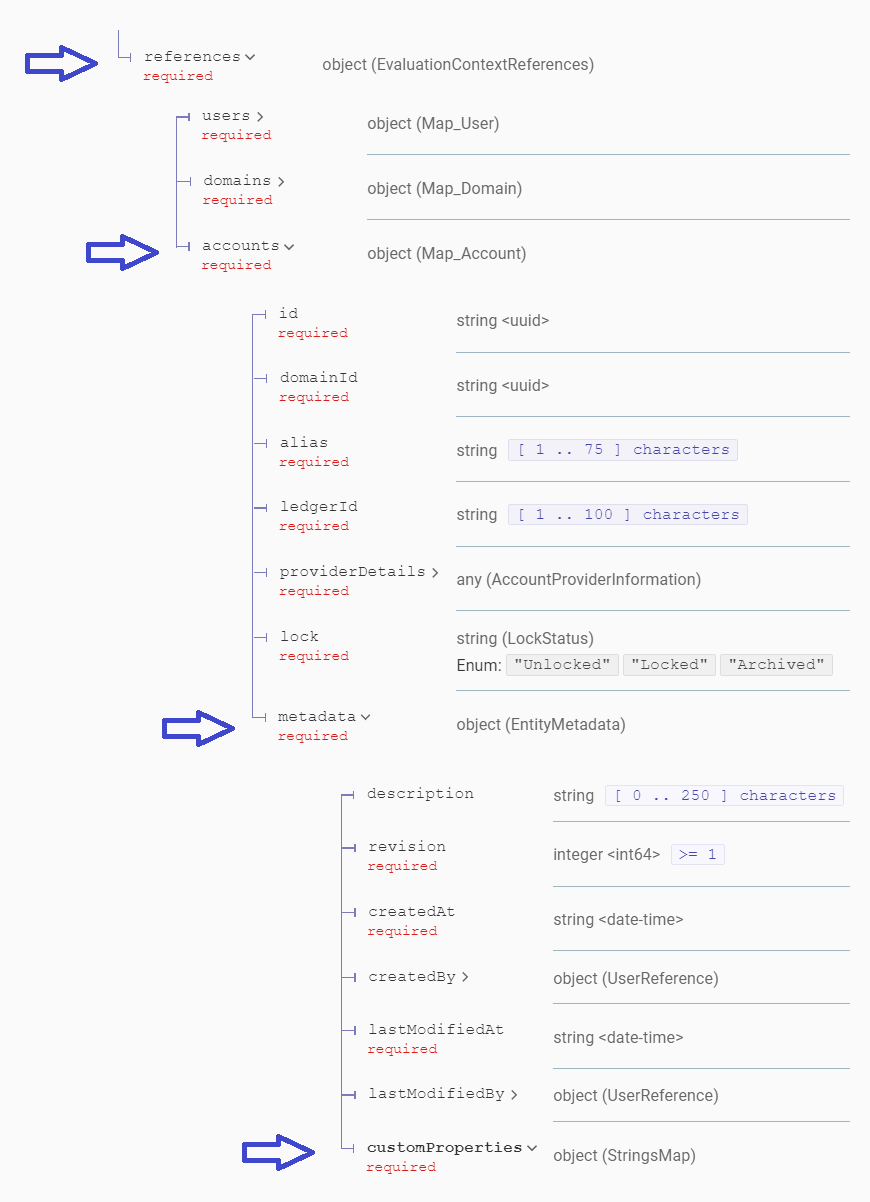
Conditions are JavaScript expressions. Write one expression that evaluates to true or false.
| Rule | Guidance |
|---|---|
Use Javascript_v0 | This is the supported scripting engine. |
| Return a boolean | The expression should evaluate to true or false for every matching intent. |
| Prefer strict paths | Check the actual payload shape for each intent type in the API reference before writing paths. |
| Check optional fields | Use hasOwnProperty, null checks, or array length checks before accessing optional nested fields. |
| Use role names exactly | Role names are case-sensitive and must match user roles. |
| Keep expressions deterministic | Avoid relying on external state. Policies cannot call APIs or query arbitrary entities. |
Supported JavaScript patterns:
| Pattern | Example |
|---|---|
| Comparison | context.request.payload.rank >= 700 |
| Logical operators | a && b, `a |
| Array includes | roles.includes('compliance') |
| Array some/every/filter | outputs.some(output => BigInt(output.amount) > 100000000n) |
| Array reduce | outputs.reduce((sum, output) => sum + BigInt(output.amount), 0n) |
| String methods | alias.startsWith('prod-'), alias.includes('treasury') |
| Object checks | payload.hasOwnProperty('parameters') |
| JSON methods | JSON.parse(rawTx), JSON.stringify(roles) |
| Date methods | new Date().getHours(), new Date().getDay() |
Amount handling:
- Use BigInt for amount comparisons.
- Use an
nsuffix for integer literals, such as50000000000n. - When the payload value is a string, wrap it with
BigInt(...). - For multi-output payloads, sum amounts with
reduce.
{
  "condition": {
    "expression": "context.request.payload.parameters.outputs.reduce((sum, output) => sum + BigInt(output.amount), 0n) >= 500000000n",
    "type": "Expression"
  }
}
Null-safe nested access:
{
  "condition": {
    "expression": "context.request.payload.hasOwnProperty('parameters') && context.request.payload.parameters != null && context.request.payload.parameters.hasOwnProperty('destination') && context.request.payload.parameters.destination.type == 'Endpoint'",
    "type": "Expression"
  }
}This condition matches when the author is an operator, the transaction parameters are Bitcoin, and either the amount is at least 1 BTC or the source account has a custom property named escalatePolicy set to true.
{
  "expression": "context.references.users[context.request.author.id].roles.includes('operator') && context.request.payload.hasOwnProperty('parameters') && context.request.payload.parameters != null && context.request.payload.parameters.type == 'Bitcoin' && (context.request.payload.parameters.outputs.reduce((sum, output) => sum + BigInt(output.amount), 0n) >= 100000000n || context.references.accounts[context.request.payload.accountId].metadata.customProperties.escalatePolicy == 'true')",
  "type": "Expression"
}This condition matches operator-created Bitcoin transactions below 1 BTC where the account is not escalated and the destination is either an unknown address or an endpoint with a trust score of 50 or lower.
{
  "left": {
    "expression": "context.references.users[context.request.author.id].roles.includes('operator') && context.request.payload.hasOwnProperty('parameters') && context.request.payload.parameters != null && context.request.payload.parameters.type == 'Bitcoin' && context.request.payload.parameters.outputs.reduce((sum, output) => sum + BigInt(output.amount), 0n) <= 100000000n && context.references.accounts[context.request.payload.accountId].metadata.customProperties.escalatePolicy != 'true' && context.request.payload.parameters.outputs[0].destination.type == 'Address'",
    "type": "Expression"
  },
  "right": {
    "expression": "context.references.users[context.request.author.id].roles.includes('operator') && context.request.payload.hasOwnProperty('parameters') && context.request.payload.parameters != null && context.request.payload.parameters.type == 'Bitcoin' && context.request.payload.parameters.outputs.reduce((sum, output) => sum + BigInt(output.amount), 0n) <= 100000000n && context.references.accounts[context.request.payload.accountId].metadata.customProperties.escalatePolicy != 'true' && context.request.payload.parameters.outputs[0].destination.type == 'Endpoint' && context.references.endpoints[context.request.payload.parameters.outputs[0].destination.endpointId].trustScore <= 50",
    "type": "Expression"
  },
  "type": "Or"
}This condition matches operator-created Bitcoin transactions below 1 BTC where the account is not escalated and the destination is either an internal account or an endpoint with a trust score of 50 or higher.
{
  "left": {
    "expression": "context.references.users[context.request.author.id].roles.includes('operator') && context.request.payload.hasOwnProperty('parameters') && context.request.payload.parameters != null && context.request.payload.parameters.type == 'Bitcoin' && context.request.payload.parameters.outputs.reduce((sum, output) => sum + BigInt(output.amount), 0n) <= 100000000n && context.references.accounts[context.request.payload.accountId].metadata.customProperties.escalatePolicy != 'true' && context.request.payload.parameters.outputs[0].destination.type == 'Account'",
    "type": "Expression"
  },
  "right": {
    "expression": "context.references.users[context.request.author.id].roles.includes('operator') && context.request.payload.hasOwnProperty('parameters') && context.request.payload.parameters != null && context.request.payload.parameters.type == 'Bitcoin' && context.request.payload.parameters.outputs.reduce((sum, output) => sum + BigInt(output.amount), 0n) <= 100000000n && context.references.accounts[context.request.payload.accountId].metadata.customProperties.escalatePolicy != 'true' && context.request.payload.parameters.outputs[0].destination.type == 'Endpoint' && context.references.endpoints[context.request.payload.parameters.outputs[0].destination.endpointId].trustScore >= 50",
    "type": "Expression"
  },
  "type": "Or"
}This condition matches user creation or update intents when the target user has the admin or compliance role.
{
  "expression": "context.request.payload.roles.includes('admin') || context.request.payload.roles.includes('compliance')",
  "type": "Expression"
}
This condition matches user creation or update intents when the target user does not have either privileged role.
{
  "expression": "!context.request.payload.roles.includes('admin') && !context.request.payload.roles.includes('compliance')",
  "type": "Expression"
}
Avoid these patterns:
| Avoid | Reason |
|---|---|
fetch, imports, network calls, or database calls | Conditions cannot call external systems. |
| DOM, browser APIs, timers, or process APIs | Policy evaluation is server-side. |
| Statements that require a block | The field expects an expression. Prefer array methods and logical operators. |
| Missing optional-field checks | Undefined nested paths can make condition evaluation fail. |
| Comparing large amounts as normal numbers | JavaScript numbers can lose precision. |
A workflow is an ordered array of approval steps. Each step must be satisfied before the next step is active.
| Type | Shape | Use when |
|---|---|---|
RoleQuorum | { "role": "operator", "quorum": 2, "type": "RoleQuorum" } | A number of users with one role must approve. |
And | { "left": {...}, "right": {...}, "type": "And" } | Multiple approval groups are required in the same step. |
Or | { "left": {...}, "right": {...}, "type": "Or" } | Either approval group can satisfy the step. |
Example workflow:
{
  "workflow": [
    {
      "role": "transaction-operator",
      "quorum": 1,
      "type": "RoleQuorum"
    },
    {
      "left": {
        "role": "compliance",
        "quorum": 1,
        "type": "RoleQuorum"
      },
      "right": {
        "role": "risk",
        "quorum": 1,
        "type": "RoleQuorum"
      },
      "type": "And"
    }
  ]
}
Workflow rules:
- For user-signed proposals, the intent submitter counts as the first approval.
- For user-signed proposals, the submitter must have a role compatible with the first workflow step.
- For system-signed proposals, the service submitter does not count as a user approval. If a system-signed policy includes a workflow, user-signed approvers must satisfy it.
- If quorum is not reached, the step remains open and users can change their decision. Once a step is executed, it cannot be changed.
- A user can count only once in the complete approval workflow.
- Duplicate approvals are checked at public-key level.
- If a user has roles on both sides of an
AndorOr, the engine uses one approval on the quickest valid path. RoleQuorum.quorummust be at least1.AndandOruseleftandright, not arrays.- An omitted or
nullworkflow auto-approves a matching intent. - An empty workflow array rejects a matching intent.
Step 1 is satisfied by the submitter with the operator role. Step 2 is satisfied by one supervisor or one supervisor-bot.
[
  {
    "role": "operator",
    "quorum": 1,
    "type": "RoleQuorum"
  },
  {
    "left": {
      "role": "supervisor",
      "quorum": 1,
      "type": "RoleQuorum"
    },
    "right": {
      "role": "supervisor-bot",
      "quorum": 1,
      "type": "RoleQuorum"
    },
    "type": "Or"
  }
]Step 1 is satisfied by the submitter with the operator role. Step 2 requires compliance or compliance-bot approval and risk or risk-bot approval. Step 3 requires one ciso approval.
[
  {
    "role": "operator",
    "quorum": 1,
    "type": "RoleQuorum"
  },
  {
    "left": {
      "left": {
        "role": "compliance",
        "quorum": 1,
        "type": "RoleQuorum"
      },
      "right": {
        "role": "compliance-bot",
        "quorum": 1,
        "type": "RoleQuorum"
      },
      "type": "Or"
    },
    "right": {
      "left": {
        "role": "risk",
        "quorum": 1,
        "type": "RoleQuorum"
      },
      "right": {
        "role": "risk-bot",
        "quorum": 1,
        "type": "RoleQuorum"
      },
      "type": "Or"
    },
    "type": "And"
  },
  {
    "role": "ciso",
    "quorum": 1,
    "type": "RoleQuorum"
  }
]The Create a policy wizard in the UI builds a v0_CreatePolicy payload. This section lists every option the wizard offers and the payload field it sets. For the procedure, see Create a policy in the UI.
The Conditions page groups the selectable intent types into Operations and Administration. Each selection adds an entry to intentTypes. Choosing All intent types omits intentTypes so the policy can match any intent type.
Operations:
| UI intent type | API intent type |
|---|---|
| Add Account Ledgers | v0_AddAccountLedgers |
| Create Account | v0_CreateAccount |
| Lock Account | v0_LockAccount |
| Unlock Account | v0_UnlockAccount |
| Update Account | v0_UpdateAccount |
| Attempt Transaction Order Cancellation | v0_AttemptTransactionOrderCancellation |
| Create Transaction Order | v0_CreateTransactionOrder |
| Create Transfer Order | v0_CreateTransferOrder |
| Release Quarantined Transfers | v0_ReleaseQuarantinedTransfers |
| Create Endpoint | v0_CreateEndpoint |
| Lock Endpoint | v0_LockEndpoint |
| Unlock Endpoint | v0_UnlockEndpoint |
| Update Endpoint | v0_UpdateEndpoint |
| Sign Manifest | v0_SignManifest |
| Execute Extension | v0_ExecuteExtension |
Administration:
| UI intent type | API intent type |
|---|---|
| Create Policy | v0_CreatePolicy |
| Lock Policy | v0_LockPolicy |
| Unlock Policy | v0_UnlockPolicy |
| Update Policy | v0_UpdatePolicy |
| Create User | v0_CreateUser |
| Lock User | v0_LockUser |
| Unlock User | v0_UnlockUser |
| Update User | v0_UpdateUser |
| Create Domain | v0_CreateDomain |
| Lock Domain | v0_LockDomain |
| Unlock Domain | v0_UnlockDomain |
| Update Domain | v0_UpdateDomain |
| Update Domain Permissions | v0_UpdateDomainPermissions |
| Create Vault | v0_CreateVault |
| Lock Vault | v0_LockVault |
| Unlock Vault | v0_UnlockVault |
| Update Vault | v0_UpdateVault |
| Lock Ticker | v0_LockTicker |
| Unlock Ticker | v0_UnlockTicker |
| Update Ticker | v0_UpdateTicker |
| Validate Assets | v0_ValidateTickers |
| Notarize Data | v0_NotarizeData |
The following intent types have no UI selector and can be referenced in intentTypes only through the API: v0_AcknowledgeBackup, v0_AddTrustedPublicKeysForMigration, v0_CreateBackup, v0_CreateLedger, v0_CreateTicker, v0_RegisterTrustedPublicKey, v0_RewrapVaultKeyMaterial, v0_SetSystemProperty, and v0_UpdateLedger.
Under Additional conditions, the wizard offers these condition types. Each condition you add becomes part of the policy's condition object, and the AND and OR selectors between conditions become And and Or nodes. The Preview tab shows the resulting JSON.
| UI condition type | Inputs | Matches when |
|---|---|---|
| Custom condition | JavaScript expression | The expression evaluates to true. |
| If intent's custom properties is | Label, value | The intent has a custom property that exactly matches the label and value. |
| If intent's custom properties contains | Label, value | The intent has a custom property with the label whose value contains the entered text. |
| If intent author belongs to domain | Domain or domain ID | The intent author belongs to the domain. |
| If intent author does not belong to domain | Domain or domain ID | The intent author does not belong to the domain. |
| If intent author is | User or user ID | The intent author is the user. |
| If intent author is not | User or user ID | The intent author is not the user. |
The Workflow page offers three options that map to the workflow field:
| UI option | Resulting workflow | Behavior |
|---|---|---|
| Approval workflow | Array with one step per wizard step | Each step must be satisfied in order. |
| Always reject | Empty array [] | Matching intents are rejected without user intervention. |
| Always approve | Omitted | Matching intents are approved without user approvals. |
In an approval workflow step, each approval group becomes a RoleQuorum object with the entered approval count as quorum and the selected user role as role. Adding another group to a step with Add condition nests the groups in an And or Or object, and Add step appends another entry to the workflow array.
The Summary page shows the policy before submission:
| Section | Fields | Payload fields |
|---|---|---|
| Policy details | Policy name, policy ID, description, rank (shown as rank/1000), custom properties, status | alias, id, description, rank, customProperties, lock |
| Conditions | Governing scope, intent types, additional conditions | scope, intentTypes, condition |
| Approval workflow | One row per step. Click See more to expand a step's approval groups. | workflow |
Role names used in users, read access, conditions, and workflows must match exactly.
| Valid | Avoid |
|---|---|
policy-operator | PolicyOperator |
transaction-operator | transaction_operator |
compliance | Compliance Team |
platform-admin | platform admin |
The API schema accepts role names that match [a-z0-9\-]+.
{
  "id": "c35fa005-1640-42ee-a8a5-c43aaae6eb87",
  "alias": "operator-approval",
  "rank": 100,
  "scope": "Self",
  "intentTypes": ["v0_CreateTransactionOrder"],
  "scriptingEngine": "Javascript_v0",
  "condition": {
    "expression": "context.references.users[context.request.author.id].roles.includes('transaction-operator')",
    "type": "Expression"
  },
  "workflow": [
    {
      "role": "transaction-operator",
      "quorum": 2,
      "type": "RoleQuorum"
    }
  ],
  "lock": "Unlocked",
  "description": "Requires transaction operator quorum.",
  "customProperties": {},
  "type": "v0_CreatePolicy"
}| Mistake | Result | Fix |
|---|---|---|
Empty workflow: [] | Matching intents are rejected. | Omit workflow or use null for auto-approval, or define approval steps. |
Omitted intentTypes on a high-rank policy | Policy can match unexpectedly broad workflows. | Specify intent types unless the policy is a deliberate fallback. |
customProperties: null | Payload validation can fail. | Use {} when empty. |
| Role names with uppercase, underscores, spaces, or padding | Workflows cannot be satisfied by expected roles. | Use lowercase hyphenated role names, such as policy-operator. |
And or Or written as arrays | Payload validation fails. | Use left, right, and type. |
| Amount compared as a JavaScript number | Precision loss or mismatched comparisons. | Use BigInt(...) and n literals. |
| Missing optional-field checks | Condition can fail for intent types with different payload shapes. | Check existence before accessing nested fields. |
| Required quorum has too few users | Intent cannot be approved. | Create enough users before deploying the policy. |
| First workflow step excludes maker role for a user-signed policy | Intent fails at submission or cannot progress. | Include the maker role in the first workflow step. For system-signed policies, make sure user approvers can satisfy the workflow. |
For implementation patterns, see Policy examples.